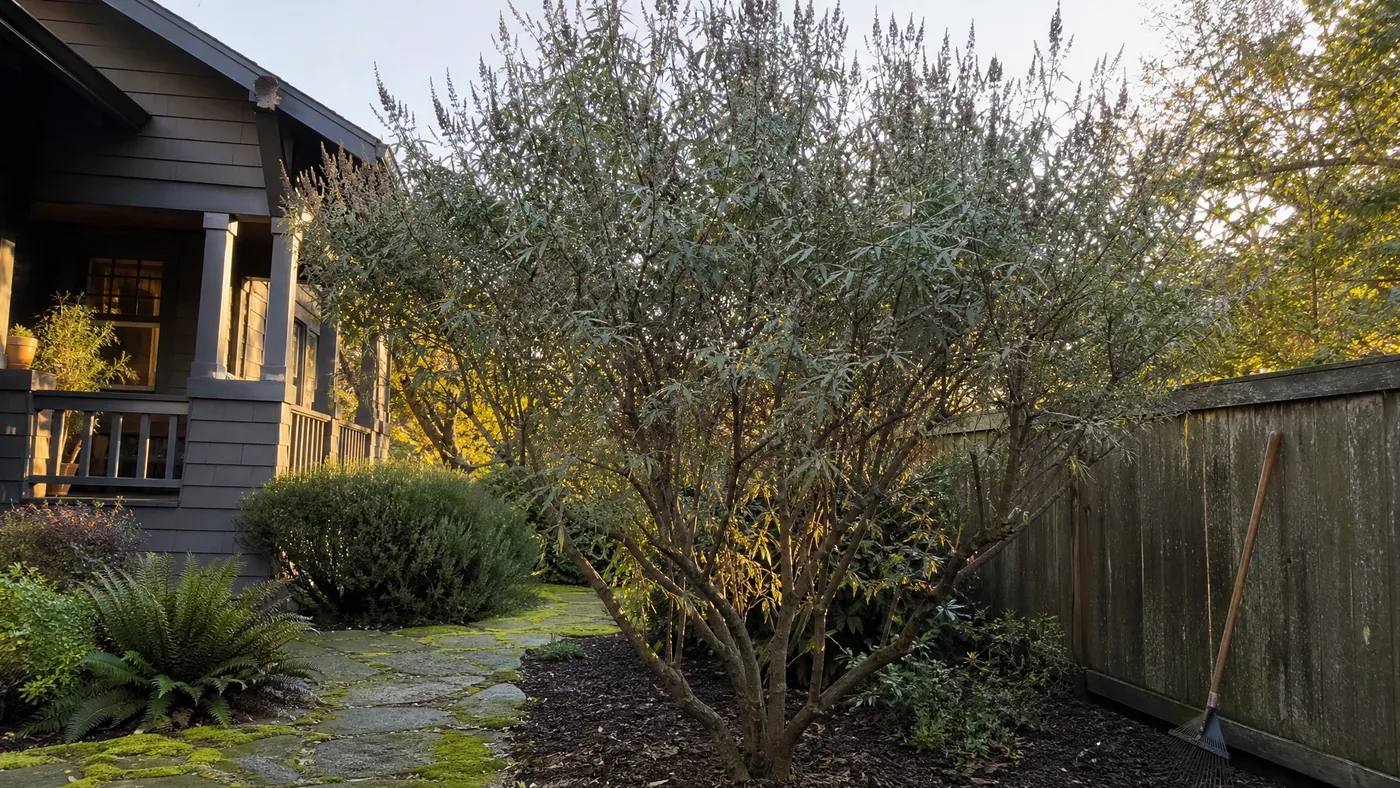
Shoal Creek Chaste Tree Pros and Cons: Is It Right for You
A nursery tag promising "tough, long-blooming, pollinator-friendly" proves nothing until you ask who measured it and in which winter. Those three words are mostly true of Shoal Creek, but each one carries a condition the tag leaves off, and the conditions are what you live with in year five.
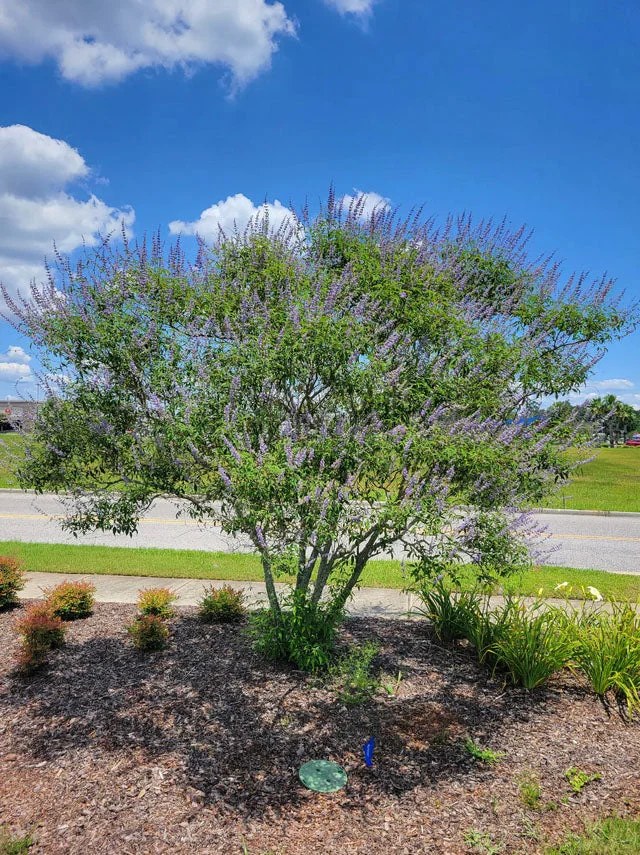
Get it wrong and you own a 15-foot shrub in a bed sized for something smaller, plus a scatter of seedlings you never planned. Get it right and you get violet-blue flower spikes through the hottest part of the year.
In this article, we'll go through the marketing claims worth checking, the heat and drought evidence, the first weeks in the ground, the pollinator record, and what dieback, pruning and seedlings cost you over the long run.
Claims Worth Doubting Before You Buy Shoal Creek Chaste Tree
Five claims turn up on nearly every tag and listing: tough, long-blooming, pollinator-friendly, deer resistant and low maintenance. Some can be checked against extension publications. Others are sales language. The table sorts them by what the sources let us confirm.
| Claim | Checkable? | What the sources support |
|---|---|---|
| Heat and drought tolerant | Yes | Good drought tolerance once established, with limits on soil |
| Long-blooming | Yes | Bloom from June to September, and a repeat flush about six weeks after removing old blooms |
| Pollinator-friendly | Partly | Extension sources say bees and other pollinators visit, but none gives counts |
| Deer resistant | Partly | Described as resistant to damage, which is not the same as deer-proof |
| Low maintenance | Mostly hype | Needs a cutback in cold zones and seedling control everywhere |
Size is the claim the tag skips entirely. Clemson gives Shoal Creek as 10–15 feet tall and 15–20 feet wide, while NC State lists 4–15 feet tall and 4–12 feet wide. When sources disagree that much, plan for the larger numbers.
A tree that has room can always be pruned smaller, but one planted too close to a walk is hard to move once it has rooted in.
Reading the Bloom Claim Carefully
The June-to-September window comes from a species-level fact sheet, and it describes a plant growing in full sun and being deadheaded. A Stanford encyclopedia entry for the species puts the show in July and August instead. Both can be true in different climates. Expect the peak in midsummer and a thinner tail on either side, and do not buy it for spring color.
What the cultivar adds is flower size. Shoal Creek is an improved cultivar with larger spikes of violet-blue flowers than the typical species. That is a real difference you can see, and it is the best reason to choose this plant over a seedling-grown one.
What the Heat and Drought Evidence Supports
Every extension source we checked agrees on the basic point. The plant tolerates drought well once established, and the University of Arkansas Extension calls it a tough, drought-resistant plant hardy from zones 6 to 9.
Stanford's entry points to plants blooming in midsummer on a highway embankment near Cupertino as proof of drought tolerance. That is a roadside observation, not a trial, but it matches everything else we read.
Now the limits. "Once established" is doing real work in that sentence, and the next section covers what it demands. The evidence is also written about the species. We found no source that tested Shoal Creek against its parent in a drought, so treat the cultivar claim as likely rather than proven.
If you garden in a dry region such as west Texas or Arizona, ask your local extension service how much supplemental water mature plants get there.
Drainage is the second limit. Arkansas notes the plant is not bothered by insects or disease apart from root rot in heavy clay, so a tree that survives a dry August can still be lost in a wet, heavy bed.
Heat tolerance does not extend to cold, either. Clemson recommends it for zones 7 to 9, tighter than the 6a–9b range NC State lists for the cultivar. Our drought guide goes further into how dry is too dry.
Our verdict: the heat and drought claim holds, as long as the tree has sun, drained soil and a full season of roots behind it.
The First Weeks Test Your Shoal Creek Chaste Tree
A new plant has not yet grown into the drought tolerance on the tag, so the first weeks are about getting roots out into your native soil. It prefers full sun and loose, well-drained soil with adequate but not wet moisture. That last phrase is the one people miss. We often see new plantings lost to kindness, with too much water on heavy soil rather than too little.
What establishment asks of you comes down to a short list:
- Pick a spot with at least 6 hours of direct sun a day, since the tree needs full sun to flower.
- Loosen heavy clay before planting, or choose a raised or sloped site, because root rot in clay is the one disease problem the sources name.
- Keep the root zone evenly moist but never soggy while new roots form, and check with your local extension service for watering frequency in your soil and climate.
- Hold back on fertilizer. The cultivar is rated a rapid grower and does not need pushing.
Hole depth, backfill and mulch details are in our planting guide, so we won't repeat them here. The point for this weighing is cost: the early weeks need attention, not heroics.
Reading the Plant Instead of the Calendar
Leaves that droop in afternoon heat but recover by evening are coping. Leaves that stay limp in the morning, or turn yellow while the soil is still damp, usually point to roots sitting wet. Check the soil a few inches down before you reach for the hose.
If the site fails the sun and drainage test, no amount of watering fixes it, and that is a better reason to walk away than any other on this list.
Do Pollinators Really Flock to Shoal Creek Chaste Tree?
The evidence is real, but it is thin on numbers. Bees and many other pollinators are attracted to the flowers and foliage, and the University of Georgia's field report calls the violet flowers a magnet for pollinators. Two universities saying the same thing counts for something. Neither gives visit counts, species lists or a comparison with another plant.
What We Can Verify
What the sources do support is the setup that makes visits likely. The species blooms from June into September, and the cultivar carries larger spikes of violet-blue flowers. A long run of flowers in the heat of summer is useful whatever else is blooming. Removing old blooms brings a repeat bloom in about six weeks, which stretches the supply further.
How It Compares With Other Bloomers
Honestly, we can't rank it. No source we found measures it against butterfly bush, native shrubs or perennials, and anyone quoting a percentage is guessing. Our advice is to treat Shoal Creek as one dependable late-season nectar plant in a mixed planting, not a replacement for the rest.
Our guide to bees and butterflies on Shoal Creek covers who visits and when.
Verdict: believable and well supported in kind, unproven in degree.
Year One Brings Dieback, Pruning and Surprises
If you garden in zone 6, expect your first cold season to be the real test. The tag will say hardy to 6a, which fits the cultivar's range. But zone 7 is as cold as it is recommended for, and the species can suffer winter dieback or die to the ground in zones 5 and 6.
Missouri State's tree notes say the same thing in plainer words: more of a shrub in the north, and it may die back to the ground in cold winters.
When Cold Cuts It to the Ground
The encouraging part is that the roots often survive and push up several feet of new growth the following year. Shoal Creek flowers on new growth from the current season, so dieback does not stop the bloom.
In zone 6 you should plan on a big shrub that rebuilds each year, not a small tree with a permanent trunk. Our winter care guide covers protection.
The Yearly Cut and What It Costs
Because it blooms on new wood, it can be cut back in winter or early spring. In cold zones that cut mostly removes what the cold already killed. Add summer deadheading if you want the repeat flush, and that is the whole job: one cutback session and some snipping.
It is not heavy work, but "low maintenance" overstates it. Technique is in our care guide.
Growth That Outruns the Tag
The surprise most owners report is speed. The cultivar is a rapid grower, and the species can add up to 24 inches a year. A plant that looked small in its pot fills its space quickly once the roots settle. In zone 6 that speed is what rebuilds the shrub after dieback, which is one genuine point in the plant's favor.
Seedlings Show Up in the Established Planting
This is the con the tag never mentions. The species freely reseeds and can become weedy, and the dry fruit can be a litter issue. UF/IFAS does not rate it invasive, but it still warns that seeds may colonize nearby landscape beds and become weedy.
How serious is that? For most yards, a nuisance and not a threat. In our rows, seedlings turn up close to the parent plant and in the mulch beside it, and young ones pull easily. The trouble starts when you ignore them for a few seasons and find woody saplings with deep roots in a perennial bed.
All of these statements describe the species. We found no source saying Shoal Creek sets less seed, so assume it behaves like its parent. The work is small but recurring: pull seedlings each spring, and remove spent flower spikes before they ripen. That second step is the same deadheading you are already doing for the repeat bloom, so the two chores merge.
Where the top growth survives the cold and flowers fully, expect more seed than in zone 6, where the cutback limits the crop. If you garden next to natural land, check with your local extension service about how the plant behaves in your region before you plant.
An Established Shoal Creek Chaste Tree Keeps Its Promises Selectively
By year five the plant has shown you what the tag only hinted at. Some benefits get better with age, and some downsides never go away. Common advice says to plant it and forget it. What we tell customers is to plant it and cut it once a year.
What Holds Up
Drought tolerance, summer bloom and pest resistance all hold. Arkansas reports no insect or disease trouble beyond root rot in heavy clay, and the species is resistant to damage by deer and moderately salt tolerant. The plant tolerates soil pH from 6.0 to 8.0, so most yards need no soil correction. A mature plant also needs far less attention than it demanded in its first weeks.
What Never Goes Away
Size, the yearly cut and seedlings persist. In a warm zone, a Shoal Creek left alone moves toward 10–15 feet tall and 15–20 feet wide, wider than it is tall. That is a lot of shrub for a foundation bed. Allow room for the width, and don't expect to keep it small without regular pruning. Dry fruit litter is a minor, steady chore as well.
Shape is the last cost. In a warm zone it grows as a vase-shaped shrub or can be trained into a small tree. In winter it is bare wood, so it will not screen a view in the cold months.
Who Should Skip It and Who Should Plant
Skip it if your only open spot is shaded, if your soil stays wet or heavy, or if the space is under about 15 feet across and you want a plant you never prune. Skip it too if you border a natural area where seedlings could escape, or if you want a tidy evergreen shape in winter. In zone 6, don't count on a tall trunk.
Plant it if you have a hot, sunny spot with drained soil and room to spread, and you don't mind a yearly cut and a few seedlings to pull. It repays that deal with late-summer color and visiting bees. So here is the one test to run before you order: do you have six hours of sun, soil that drains, and a winter you can handle with a pair of loppers?
Shoal Creek Chaste Tree
Nursery-grown Shoal Creek Chaste Tree in sizes from QT Container 6-8 Inches Shrub Form, shipped to your door.
From $49.49
Shop Now →On our farms, Shoal Creek gets open rows with room to spread and a full day of sun, so we see its width and its seedlings firsthand, not just on a tag. We only ship plants we would plant ourselves, top-quality trees and shrubs. If it passes your test, come and see the plants we have ready.