Is Shoal Creek Chaste Tree Native to the United States?
A neighbor leans over the fence and says the purple spires in your border are a Texas wildflower, and you realize you have never checked. It is an easy mistake, because Shoal Creek chaste tree blooms hard through Southern summers and looks like it grew up right there.
The answer matters for more than trivia. Plant it expecting a native and you may skip the seedling patrol it needs, or you may count it as habitat for local wildlife in ways it cannot deliver.
We'll walk you through where the plant actually comes from and what a cultivar name does and does not change, then how it handles zones 6 to 9, whether its seedlings are a worry, and what it gives local pollinators.
Is Shoal Creek Chaste Tree a Texas Native?
No. Shoal Creek chaste tree is not native to Texas, and it is not native to the United States. The species behind it, Vitex agnus-castus, is native to Europe, western Asia, India and North Africa. We have found no source that places a wild population of it on this continent.
One of the most common questions we get is whether it is a Texas wildflower. We understand the confusion. It blooms from June through September, shrugs off heat, and fills so many Southern yards that it looks like part of the landscape.
Looking local and being local are different things. A native plant evolved in a region and grew there before people started moving plants around. Chaste tree reached American gardens because people brought it, which makes it an introduced garden plant, however well it settles in.
Its Texas reputation comes from performance. A shrub that flowers for months with little help gets noticed and talked about, and that reputation is earned. It tells you how well the plant grows here. It tells you nothing about where the plant began.
How to Check Any Plant's Origin
You can settle this question for any plant in a few minutes. Start with the full botanical name on the tag, here Vitex agnus-castus 'Shoal Creek', and search that name rather than the common name. Common names like vitex and chaste tree are used loosely, and a loose name is how a rumor about a Texas wildflower gets started.
Then read the first lines of a university extension page. Most open with a "native to" statement, and the page for this species does exactly that. If the region named is not your state or your country, you are looking at an introduced plant.
Where the Species Behind Shoal Creek Chaste Tree Comes From
The species originates in a region that runs from the Mediterranean to Pakistan. That is a long arc of dry-summer country, and it explains most of the habits you see in your yard. A plant from that part of the world expects hot, bright summers and soil that drains, and it flowers best when it gets them.
Stanford's tree guide calls it a heat-loving shrub or small tree, and it has good drought tolerance once established. Those are the traits of a plant that spent its history in places where summer rain is not guaranteed. Wet feet are the one thing it was never built for.
How it reached American gardens is a question the sources we rely on do not answer with a date or a route, so we will not invent one. What they do show is where it ended up. Extension services across the South and beyond now list it as a large shrub or small tree for sunny landscapes.
The shape you get depends on climate. Missouri State describes the species growing 15 to 25 feet tall as a small tree in the South, and more of a shrub in the north where it may die back to the ground in cold winters. Plan for year five with that range in mind.
What Year Five Looks Like
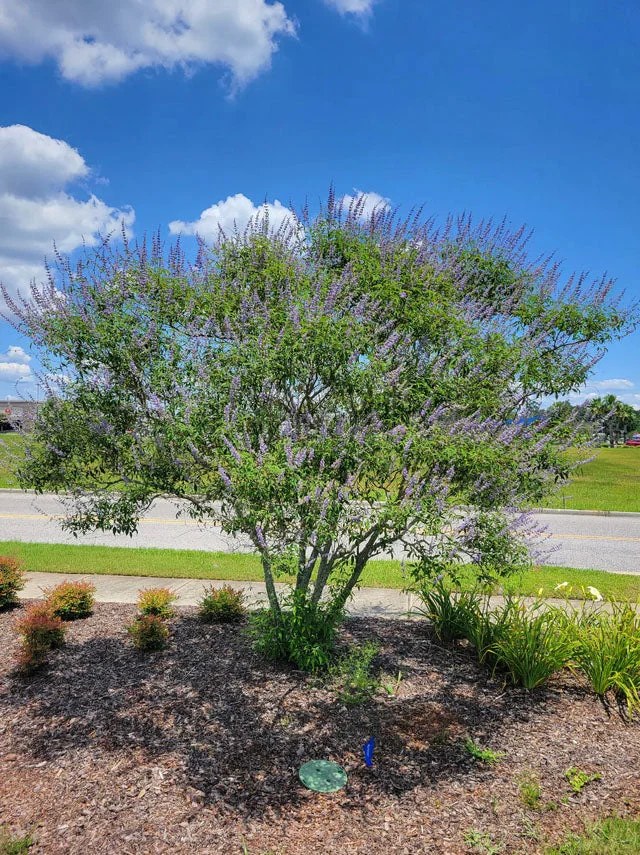
'Shoal Creek' reaches 10 to 15 feet tall and 15 to 20 feet wide at maturity, and it grows rapidly. In a landscape, that means a wide vase of gray-green foliage with flower spikes at the branch tips. Give it room to spread instead of wedging it against a wall or walkway.
If you want a screen, space plants with that mature width in mind and expect them to knit together within a few seasons. If you want a single specimen, you can train it up into a small tree by clearing the lower stems, which is a common way to grow the larger forms.
Does a Hybrid Name Change the Answer?
Some customers figure that a name in quotation marks, like 'Shoal Creek', means someone developed the plant here, so it must count as a native selection. It does not. A cultivar is a form of a plant picked for particular traits and then propagated so those traits stay the same. The parent's origin comes along with it.
A hybrid is a different thing: a cross between two parent plants. Not every cultivar is a hybrid, and the sources we use list Shoal Creek as a cultivar of Vitex agnus-castus, not as a cross. Either way, the label tells you how the plant was selected or bred. It does not tell you where the species lives in the wild.
The botanical name says it plainly. Vitex agnus-castus 'Shoal Creek' is a cultivar of the species, so it carries the species' Old World roots. Choosing a better-looking form does not move a plant's homeland, any more than a bigger rose bloom makes a rose a prairie plant.
What the cultivar name does change is garden performance. It is an improved cultivar with larger spikes of violet-blue flowers than the typical species. Its hardiness also runs from zones 6a through 9b, compared with 7a through 8b for the species.
Those are gains in flower show and cold tolerance, not in nativity. Native plant selections, the ones sometimes called nativars, start from a species that already grows wild in your region. Chaste tree has no such wild form here to select from. If you are weighing Shoal Creek against other chaste trees, our comparison of Shoal Creek with other chaste trees goes through the differences.
Why Shoal Creek Chaste Tree Naturalizes Across Zones 6–9
The next belief runs the other way: if a plant thrives almost everywhere, it must belong here. Thriving shows adaptability, and chaste tree has plenty. It tolerates heat and dry spells, accepts a pH range of 6.0 to 8.0, and the University of Arkansas notes that it is not particular about soil type.
The one soil it dislikes is the heavy, wet kind. Arkansas Extension warns of root rot in heavy clay, and the plant wants loose, well-drained soil with adequate but not wet moisture. Add full sun, meaning six or more hours of direct light, and you have the whole recipe.
Sources draw the cold line in slightly different places, which matters if you garden near the edge. This table compares what they say.
| Source | Zones | What it says |
|---|---|---|
| Shoal Creek | 6a–9b | Full cultivar range |
| Clemson | 7–9 | Dies back in zone 6 and colder |
| Texas Tech | 6–9 | Drought-tolerant, full sun to part shade |
| Arkansas Extension | 6–9 | Tough, drought-resistant |
Clemson calls it an excellent selection for southern landscapes in zones 7 to 9, and we agree. In zone 6, expect it to behave like a perennial that regrows each spring, so plan the bed around a shrub that starts the season small. Our hardiness zones guide helps you place your own yard.
Other Tough Traits
The plant also resists deer damage and is moderately salt tolerant, and Arkansas Extension says insects and disease rarely bother it. Together with the heat and drought tolerance, that explains why it turns up in parking strips, roadside plantings and neglected corners.
None of that makes it native. It makes it a plant that fits a wide set of conditions, which is exactly why it can slip out of the garden and settle in nearby.
Escaped Seedlings and the Invasive Worry
The belief that worries people most is that chaste tree spreads aggressively into wild areas. The sources are split, and the split is useful. NC State says the species freely reseeds and can become weedy, with potential to become invasive in southern areas. UF/IFAS says vitex is not considered invasive by its assessment of non-native plants, though seeds may colonize nearby beds.
Birds are part of the picture. UF/IFAS notes that small birds are attracted to the seeds, and birds can carry them beyond your fence. If you garden next to a natural area, check with your local extension service about the plant's status in your county before you plant.
In our rows, a few seedlings pop up around the older plants every season, and they come out with a gentle tug while small. That is the practical reality of a plant that reseeds. It is a chore, not a crisis, but it is one you should plan for.
What to Pull and When
Seedlings are easiest to deal with in their first season, before the root runs deep. A short routine keeps them under control:
- Check under and around the plant in early summer, then again in fall, looking for small seedlings that resemble miniature versions of the parent.
- Pull them after rain or watering, when the soil is soft, and take the whole root.
- Remove spent flower spikes. Removing old blooms encourages a repeat bloom in about six weeks, and it also cuts seed set.
- Look at nearby beds and the edge of any wild area, since that is where escapes show up first.
Mulch helps too. A layer over bare soil under the shrub makes seedlings easier to spot and easier to pull, and it keeps the soil moist enough that the roots slide out intact.
If your worry is the roots rather than the seeds, our guide to the root system and whether it is invasive covers that separately.
What Shoal Creek Chaste Tree Offers Local Wildlife
Another assumption is that a non-native plant is useless to pollinators. For this one, that is wrong. Bees and many other pollinators are attracted to its flowers and foliage, and the University of Georgia describes the violet flowers as a magnet for pollinators.
Timing adds to its value. Bloom runs from June through September, so it keeps feeding insects after many spring shrubs have finished. Our guide to how it attracts bees and butterflies shows what to expect on the spikes.
Birds get something too. The seeds attract small birds, which is useful for wildlife and is also the reason seedling patrol matters.
How It Compares With True Natives
Here is where we stay honest. A native shrub grows alongside the insects of its region, and it can do jobs a chaste tree has not been shown to do. We have no source showing that Shoal Creek hosts local caterpillars, so do not count on it for that.
Think of it as a late-season nectar plant with a long season, not a replacement for natives. Planted next to a few true natives, it covers a gap in the calendar and the natives cover the rest. A bed that mixes both gives wildlife more than either would alone.
Shoal Creek Chaste Tree Is Adopted, Not Native
The settled facts are simple. Shoal Creek is non-native by origin, since the species comes from Europe, western Asia, India and North Africa. It is well adapted by performance, with heat, drought and a wide soil range behind its success across zones 6 to 9. It reseeds, so you need to pull seedlings.
That combination makes it a good garden neighbor when you use it with care. Give it full sun and drained soil, leave it its full mature width, and keep spent spikes cut back. Treat it as a plant you chose on purpose, not one that belongs to the local wild.
Our practical suggestion is to pair it with a few true natives in the same bed that share its need for sun and drainage, and to note its origin on the plant label so anyone who asks knows the answer. The landscape design ideas for Shoal Creek show how to mix it with other plantings.
Shoal Creek Chaste Tree
Nursery-grown Shoal Creek Chaste Tree in sizes from QT Container 6-8 Inches Shrub Form, shipped to your door.
From $49.49
Shop Now →Here on our farms, Shoal Creek gets a sunny spot and loose, fast-draining ground, the same setup this guide suggests for a plant you chose on purpose. Every shrub we send out is one we would put in our own beds, grown to a top-quality standard. If you have decided this adopted favorite belongs in your yard, come and see the Shoal Creek chaste trees we have ready.