Shoal Creek Chaste Tree Root System: Is It Invasive?
Under a Shoal Creek chaste tree is a mass of fine, fibrous roots that spreads outward and then stops. There is no deep taproot and no runner sending up new shoots across the lawn. That one fact settles most of what people worry about before they plant.
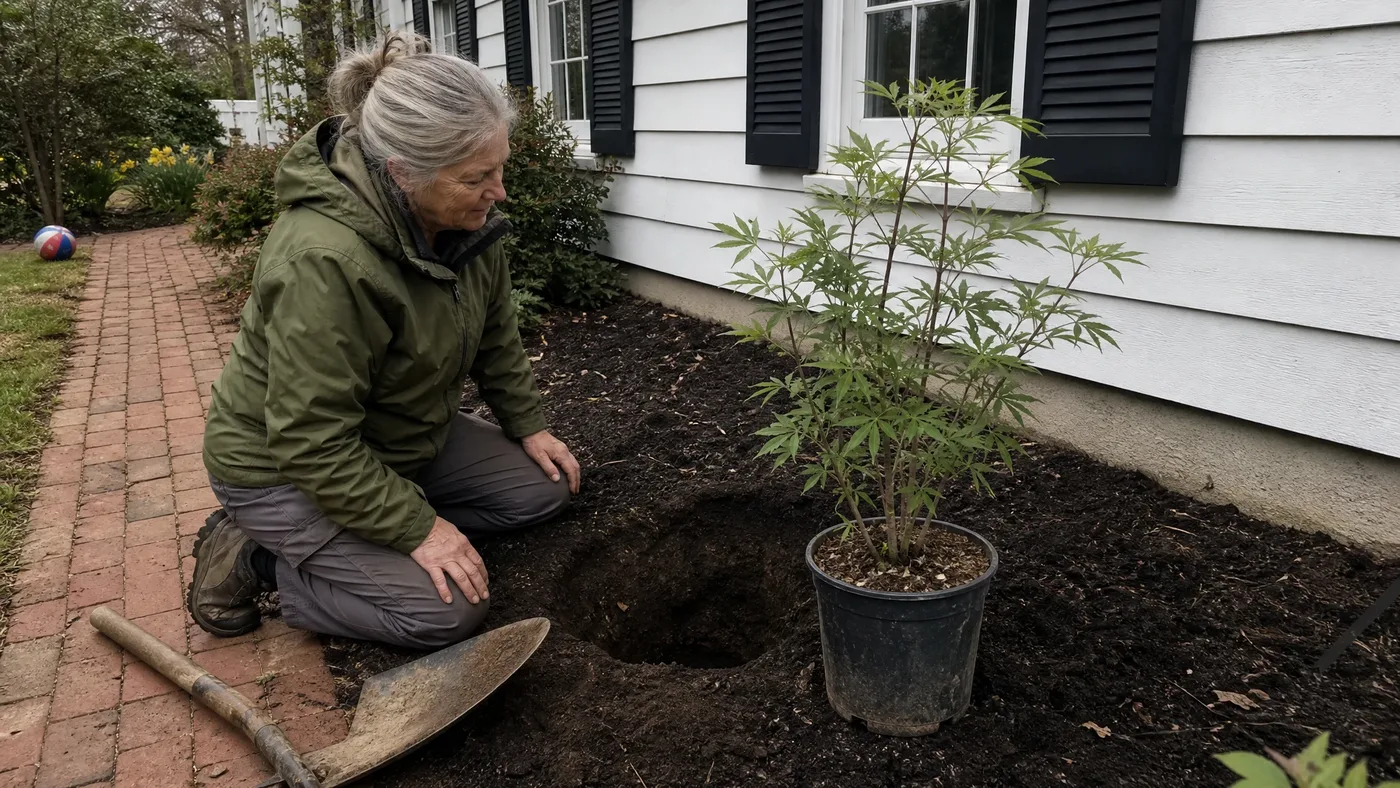
The worry is reasonable, because fast-growing plants near a house make people nervous, and the word "invasive" gets used loosely. Plant it too close and the trouble is mostly the canopy and the crowded soil, not roots that wreck things. Plant it with room and you will not move it later.
Below, you'll find out all about how these roots behave, including how far they reach, why pavement is rarely at risk, which distances to measure from walls, walks and septic lines, and the order to work through before you dig.
How a Shoal Creek Chaste Tree Builds Its Roots
Start with the structure, because everything else follows from it. A Shoal Creek builds a dense, fibrous root system: many fine and medium roots branching close to the trunk and fanning outward. It does not drive one thick taproot straight down, and it does not send out long runners that pop up as new stems feet away.
That is the difference between a plant that stays where you put it and one that wanders. Suckering plants such as some sumacs and poplars spread by underground stems. Shoal Creek does not. One trunk or cluster of trunks stays one plant.
Roots That Outlast the Top Growth
The root mass is also tougher than the stems above it. In cold winters the top growth can die back, but the roots often survive and new growth can occur the next year. A plant that resprouts from the crown is not spreading. It is the same root system waking up.
Roots Versus Seedlings
Keep two questions apart. Roots do not run. Seeds can. The species has the potential to become invasive, especially in southern areas, and that concern is about reseeding. We come back to what to do about it in the last section.
Fibrous Roots Spread Wide but Stay Shallow
Because the system is fibrous, it spreads sideways more than it goes down. Expect the root zone to track the canopy: wherever the branches reach, the feeding roots are in the soil underneath, and a little past it. That is why we measure setbacks from the spread, not from the trunk height.
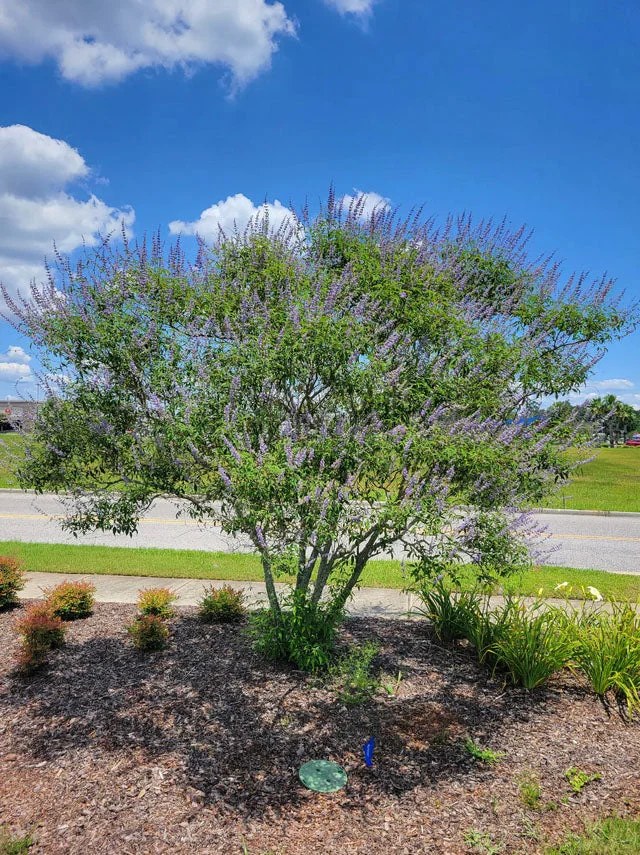
Clemson gives the cultivar's mature size as 10 to 15 feet tall and 15 to 20 feet wide. NC State lists a smaller 4–12 feet of width for the cultivar. Plan on the larger number. A tree that ends up smaller is a pleasant surprise, and one that reaches 20 feet wide is not.
Moisture Shapes the Reach
Roots go where water is. In a dry, well-drained bed, the system stays compact and tight to the plant once it is established. Near a leaking downspout, an irrigation line or a damp trench, fine roots will gather there. We tell customers to watch where the water is, not just where the pipes are.
That does not mean you should keep the soil wet. Shoal Creek wants loose, well-drained ground, and the Arkansas extension service warns of root rot in heavy clay soils. Our soil and drainage guide covers how to test for it.
Why Shoal Creek Chaste Tree Roots Rarely Lift Pavement
Pavement heaves when thick, woody roots grow under a slab and swell year after year. That is the habit of big shade trees with strong surface roots, and of trees with heavy taproots that push upward. A shrub-sized plant with a shallow mass of fine roots does not apply that kind of force.
So the real risk to a walk, patio or driveway is small, and it is not zero. Fine roots will enter an existing crack or a gap beside a slab looking for moisture. They do not make the crack. Most trouble we hear about comes from planting too close, then pruning hard to keep the canopy off the concrete.
One of the most common questions we get is whether it is safe to plant right beside a patio. Our answer is that roots are probably fine, but the tree will not be. A canopy that wants 15 to 20 feet does not fit in a 3-foot strip.
The more practical problems near hard surfaces are these:
- Branches that arch over a walk and drop spent flowers on the surface.
- Heat reflected off a wall or driveway, which this sun-loving plant handles well but which dries a narrow bed fast.
- Crowded soil under pavement that stays compacted and starves roots of air.
Measuring Setback Distances Before You Dig
Measure from the center of the planting spot, where the trunk will stand. Then take the distance to each feature in the order below. The numbers are our working rules, built from the mature spread Clemson gives. Half of 15 to 20 feet is about 8 to 10 feet, which keeps the canopy off the structure and the root mass beside it, not under it.
| Measure to | Keep this far from the trunk | Reason |
|---|---|---|
| House wall or foundation | About 8 to 10 feet | Half the mature spread, so branches clear the wall |
| Walk, patio or driveway | About 8 to 10 feet | Gives the canopy and root mass room beside the slab |
| Septic tank and drain field | Full mature spread, 15 to 20 feet | Keeps roots out of wet lines |
| Buried water, sewer or drain lines | Full mature spread, 15 to 20 feet | Roots follow moisture toward joints |
Do the structure measurements first, because they are the quickest and set the outer limit on the spot. Then move to the lines. If your plant will be pruned to stay smaller, you can lean toward the low end, but do not plan around pruning you may not do.
Local rules and soil can change these numbers. Check with your local extension service or building office, especially near a septic field.
Septic Lines and Buried Utilities Need More Room
Give anything that carries water or waste the full spread, not half of it. A sound pipe is no problem. A pipe joint that leaks a little is a steady supply of water and nutrients, and fine roots find it. Shoal Creek is a drought-tolerant plant, but its fibrous roots go for moisture wherever it appears.
A septic drain field is the highest-stakes case. It is built to keep moisture near the surface, which is just where a shallow, spreading root system lives. Keep the tree outside the field, upslope if you can, and out beyond the canopy's reach in every direction.
Know What Is Down There
Before you pick a spot, find the lines. Call your local utility-locating service and have buried gas, power, water and sewer marked, and ask the septic installer or the county for a map of the tank and field. Do not guess from where the cleanout is.
Why the Extra Room Pays Off
Digging up a mature tree to repair a line is a bad day for everyone. Leave 15 to 20 feet and a repair crew can work without touching the plant. This is also one case where we would rather you plant a smaller shrub than squeeze a Shoal Creek in.
Siting a Shoal Creek Chaste Tree Step by Step
Work in this order and you will catch problems while they are still cheap. It is the same sequence we use when we pack and route an order: confirm the details before anything moves.
- Mark the spot. Set a stake or a can of marking paint where the trunk will go. Choose full sun, which means 6 or more hours of direct sunlight a day.
- Measure to the house. Run a tape from the stake to the nearest wall. Move the stake until you have 8 to 10 feet or more.
- Measure to pavement. Repeat for every walk, patio and driveway edge. Take the shortest distance each time.
- Check the lines. Have utilities marked and confirm where the septic tank and field sit. Keep 15 to 20 feet from all of them.
- Look up. Check for overhead wires and eaves. The plant tops out at 10 to 15 feet, and branches need space.
- Test drainage. Fill the proposed hole with water and watch it drain. Slow drainage means moving the site or planting on a mound.
- Dig. Only now start the hole. Our planting guide covers digging and spacing from here.
If the spot fails any step, move the stake and start that step again rather than bending the rule. In our rows, the plants that cause grief later are almost always the ones squeezed in "just this once." Our size guide shows what year five and beyond looks like.
Shoal Creek Chaste Tree Roots Are Well-Behaved Neighbors
The root verdict is simple. The roots are fibrous, shallow-spreading and non-suckering, so they will not tear up slabs or send runners into the lawn. What is left to watch is small, and you can check it from a lawn chair.
Use this checklist once a year, in late winter:
- Look for seedlings under and near the tree, and pull them while they are small. UF/IFAS does not consider it invasive, but its extension notes that seeds may colonize nearby landscape beds and become weedy.
- Check that mulch is not piled against the trunk, and that the soil around the root zone still drains.
- Watch for water pooling or leaking near the root zone, and fix leaks quickly.
- Prune for shape before spring growth. Flowers form on new wood, so winter or early spring cutting does not cost you bloom.
Established plants need little water, so see our watering guide for how to taper off. In colder zones, expect top growth to die back some winters while the roots carry on, as our winter care guide explains.
Measure Once, Plant Once, Move Never
Keep about 8 to 10 feet from walls and pavement, and 15 to 20 feet from septic lines and buried utilities, measured from the trunk. Do that and a Shoal Creek will not need to be moved later. Its roots stay put, and the plant simply gets bigger and better each year.
Shoal Creek Chaste Tree
Nursery-grown Shoal Creek Chaste Tree in sizes from QT Container 6-8 Inches Shrub Form, shipped to your door.
From $49.49
Shop Now →Shoal Creek's roots stay where you put them, and on our farms we give it full sun, loose soil that drains fast and room to fill out in open rows. We are a small business that grows its own stock, so the shrubs we sell are top-quality ones we raised ourselves. If this guide has helped you pick a spot, take a look at what we have in stock now.