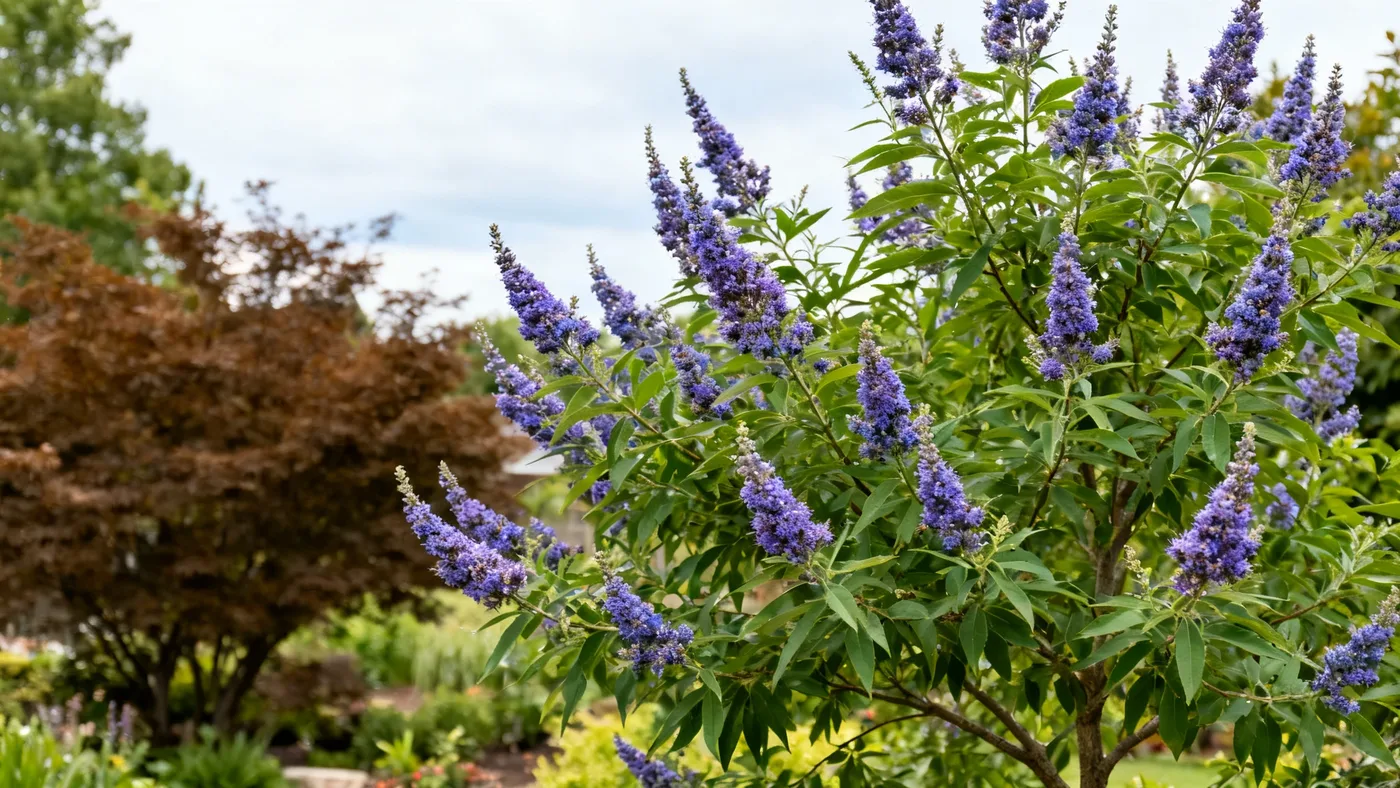
Shoal Creek Chaste Tree Bloom Time and Flower Color Guide
A common mistake with Shoal Creek Chaste Tree is tucking it into a shady corner and then waiting for flowers that never come. It wants real sun. Without it you get a leggy shrub with a few thin spikes in July. Given a bright spot, it covers itself in violet-blue color from early summer into fall.
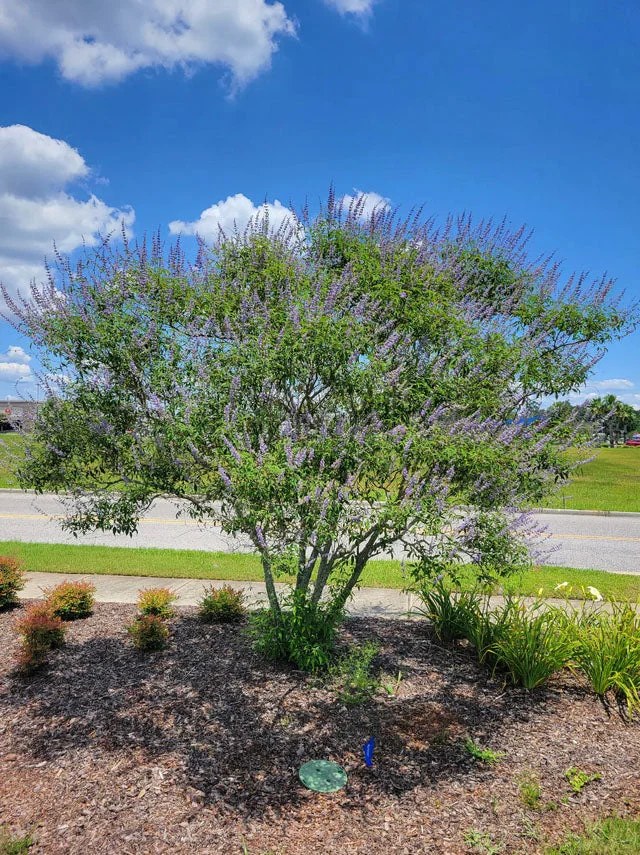
It's October as we write this, so the show is ending in cooler regions and winding down in warmer ones. That makes it a good time to look back over the whole year. This article talks about Shoal Creek's bloom time, flower color and the seasonal care that keeps it flowering, and answers the questions customers ask us most. Read on to learn what happens month by month, how long each flower spike lasts, and when to prune and deadhead.
Late Winter and Spring: Getting Shoal Creek Ready to Bloom
The flowers you see in July are decided by what you do before April. Here is how we handle the dormant season and the first flush of growth.
Prune hard in late winter. Shoal Creek Chaste Tree responds best to annual hard pruning in late winter or early spring, before new growth emerges. Cut the plant back by a third to a half of its height. This encourages a fuller branching structure and denser flower production in the coming season. Without this annual pruning, the plant becomes sparse and leggy over time, with flowers only at the branch tips.
One common tip we don't follow is shearing the tips lightly each spring. Shearing builds a dense knot of twigs with flowers only on the outside, so we cut back to a framework of strong branches instead. Our pruning guide shows the cuts step by step.
In spring, as new growth emerges after your late-winter pruning, the plant will be establishing its framework for the entire blooming season. This is a good time to ensure it has consistent water and a light feeding if your soil is poor. By late May, blooms should be starting.
Shoal Creek blooms on new wood, so flowers form on branches that grew earlier that same season. Growth is rapid, up to about 2 feet in a year in our rows. It matures at 10 to 15 feet tall and 15 to 20 feet wide, so by year five it is a real screen and needs room. If that is too much room, other Vitex cultivars may suit your space better.
Avoid excessive fertilizing. This plant is a light feeder. A balanced fertilizer applied in early spring is usually sufficient. Over-fertilizing favors foliage growth at the expense of flowers, which is the opposite of what you want.
June Through September: Shoal Creek Chaste Tree Bloom Time Month by Month
Bloom time depends on your zone, but the pattern is the same everywhere. Here is the usual calendar and how each stretch of the season looks.
Shoal Creek begins to bloom in June and continues until September, and after a warm spring we often see the first color in late May. The most abundant flowers arrive in mid-summer. In USDA zones 8 and 9, bloom can extend into early October if conditions remain warm. In zones 6 and 7, the window is more compressed, generally peaking in July and August before cooling temperatures slow flower production in September.
Late May to early June: First flowers appear as temperatures warm and day length increases. These opening blooms are often lighter in color, sometimes almost pale lavender, and appear in smaller clusters than peak-season flowers.
July through early August: This is prime bloom time. The plant is producing maximum flower panicles, which are notably larger on the 'Shoal Creek' cultivar than on the species type. Growth is vigorous, and if you deadhead spent flower clusters, the plant responds by putting energy into new flowering shoots rather than seed production.
Late August through September: Blooms continue, though the pace can slow slightly as nights cool. In zone 9, flowers are still prolific. In zones 6 and 7, production may taper, but you'll still see consistent color if you've been deadheading.
Shoal Creek Flower Color: What to Expect
Color is the reason most people buy this shrub, so here is what you will see and how it changes through the season.
The flower color of Shoal Creek Chaste Tree is one of its most reliable features: a soft lavender-blue to violet-blue that reads as both peaceful and distinctive in a garden bed. This is not hot pink, not pure white, not orange. It is a cool, almost translucent blue-purple that works beautifully alongside silver-foliaged plants, soft yellows, and other cool tones.
The color stays consistent through the season, though early-season flowers can look slightly paler or more lavender-tinted. As summer goes on, the violet-blue often deepens a little, particularly on panicles in full sun. 'Shoal Creek' also carries larger spikes of violet-blue flowers than the typical species, which is why we grow it over seedling chaste trees. Peak color intensity typically coincides with peak bloom in July and early August.
The plant's gray-green foliage, which has a palmately compound, almost hemp-like appearance, provides a neutral backdrop that lets the flower color stand out without competition. When you brush against the foliage, you'll notice a pungent, sage-like aromatic scent, which is a bonus if you enjoy fragrant plants. The flowers themselves carry a light fragrance that's pleasant but subtle, not showy.
One practical note: the flower panicles don't all open at once. Each cluster has flowers that open sequentially over a week or two, which extends the visual display and gives the plant a naturally varied, less artificial appearance than plants where all blooms open simultaneously.
Midsummer Care: Deadheading, Sun and Water
Summer is when you decide whether you get a few weeks of flowers or a long run. Two habits make the difference, and we cover both here.
How Long Do Chaste Tree Blooms Last on the Plant?
This is the question customers ask us most, so here is the answer along with what you can do to stretch it.
Individual flower panicles typically remain attractive for 2 to 3 weeks once they open fully. If you don't deadhead, the flowers fade to tan or pale brown seed capsules, and birds eat the berries, called chasteberries. However, once a panicle has finished flowering and turned to seed, the plant stops making new flowers in that location.
This is where deadheading becomes a game changer. If you remove spent flower panicles before seeds set, the plant interprets this as a signal to make more flowers. Instead of directing energy into seed production, it produces new flowering shoots from lower down on the stem. This habit can extend your bloom time by 4 to 6 weeks, pushing the tail end of blooming well into September and, in zone 9, possibly into October.
Clemson notes that removing old blooms encourages a repeat bloom in about six weeks, and that matches what we see in our rows.
Deadhead consistently. This is the single most effective way to extend bloom time. Remove spent panicles by pinching or cutting them off just below the faded cluster. Do this every 1 to 2 weeks throughout the summer if you have time. The plant will reward this effort by producing new flowers until frost threatens.
The total bloom duration from first flowers to last flowers is typically 4 to 5 months (May through September), but the density and intensity of flowers change week by week. Plan for the longest, most showy display in July and August, and for lighter, more scattered blooms in May and September.
Sun, Water and Watching the Site
Deadheading only works if the plant has what it needs underneath. Sun comes first, then water while the shrub is young.
Sun is non-negotiable. Shoal Creek Chaste Tree requires a minimum of 6 hours of direct sun per day for reliable flowering. Flowering and overall plant form decline noticeably in part shade. If your site gets fewer than 6 hours of sun, you will see fewer flowers and the shrub may become leggy. Choose a spot that receives afternoon sun, which is more reliable than morning sun alone.
Provide consistent water while young. Young plants need regular watering to establish a strong root system, which in turn supports robust growth and flowering. Once established, Shoal Creek Chaste Tree is drought-tolerant and requires only low to moderate water, but during its first year or two and during extended dry periods, consistent moisture will keep flowers coming.
Throughout summer, stay on top of deadheading if you want continuous color. This is also when you can see if the plant is getting enough sun. If blooms are sparse or mostly at the branch tips, the site may be too shaded for a move next year or increased sun exposure is needed.
If the shrub still won't flower after you have fixed the sun, read why your Shoal Creek Chaste Tree is not blooming for the other usual causes.
Fall: Where Your Shoal Creek Chaste Tree Stands This Month
It's October, so the season is closing out. Here is what to expect from the flowers now and what to do before winter.
October and beyond: In zones 8 and 9, occasional blooms may appear into early October. In zones 6 and 7, frost typically ends the display by late September.
In fall, as temperatures drop, stop deadheading by mid-September. Let the plant focus its energy on hardening off for winter rather than producing new flowers. This final phase of preparation is especially important in zones 6 and 7, where winter survival depends on good dormancy signaling.
For more detailed year-round care, see the complete growing guide. If you're curious about the plant's mature size and how to manage it in your landscape, learn how big a Shoal Creek Chaste Tree really gets.
Bloom Time Quick Reference
This table pulls the key timing and care points for Shoal Creek into one place.
| Timing Element | Details |
|---|---|
| Bloom season | Late May or June through September, and possibly into early October in zones 8-9 |
| Peak bloom | July and early August |
| Flower color | Lavender-blue to violet-blue, consistent throughout the season |
| Individual panicle duration | 2 to 3 weeks, longer if not deadheaded (turns to seed) |
| Total blooming months | About 4 months (June-September), extended with deadheading |
| Sun requirement for blooms | Minimum 6 hours direct sun per day |
| Best practice to extend blooms | Deadhead spent panicles every 1-2 weeks through summer |
| Annual pruning timing | Late winter/early spring, before new growth, cut back 1/3 to 1/2 |
| Growth rate | Rapid, up to about 2 feet per year until mature size |
| Cold hardiness zones | Listed for zones 6a through 9b, best in 7-9, and dies back to the ground in zone 6 and colder |
A Shoal Creek Calendar From Pruning Cuts to First Frost
Shoal Creek rewards a simple yearly rhythm. Prune in late winter, give it full sun, deadhead through summer, and stop in mid-September so it can settle in for winter. Do that and you can count on violet-blue spikes from June until frost, with the heaviest show in July and August.
Shoal Creek Chaste Tree
Nursery-grown Shoal Creek Chaste Tree in sizes from QT Container 6-8 Inches Shrub Form, shipped to your door.
From $49.49
Shop Now →Customers come back to us for Shoal Creek because it flowers on schedule and fills a screen quickly, and they trust plants from our own farms. We are growers, and we raise and sell top-quality trees and shrubs.