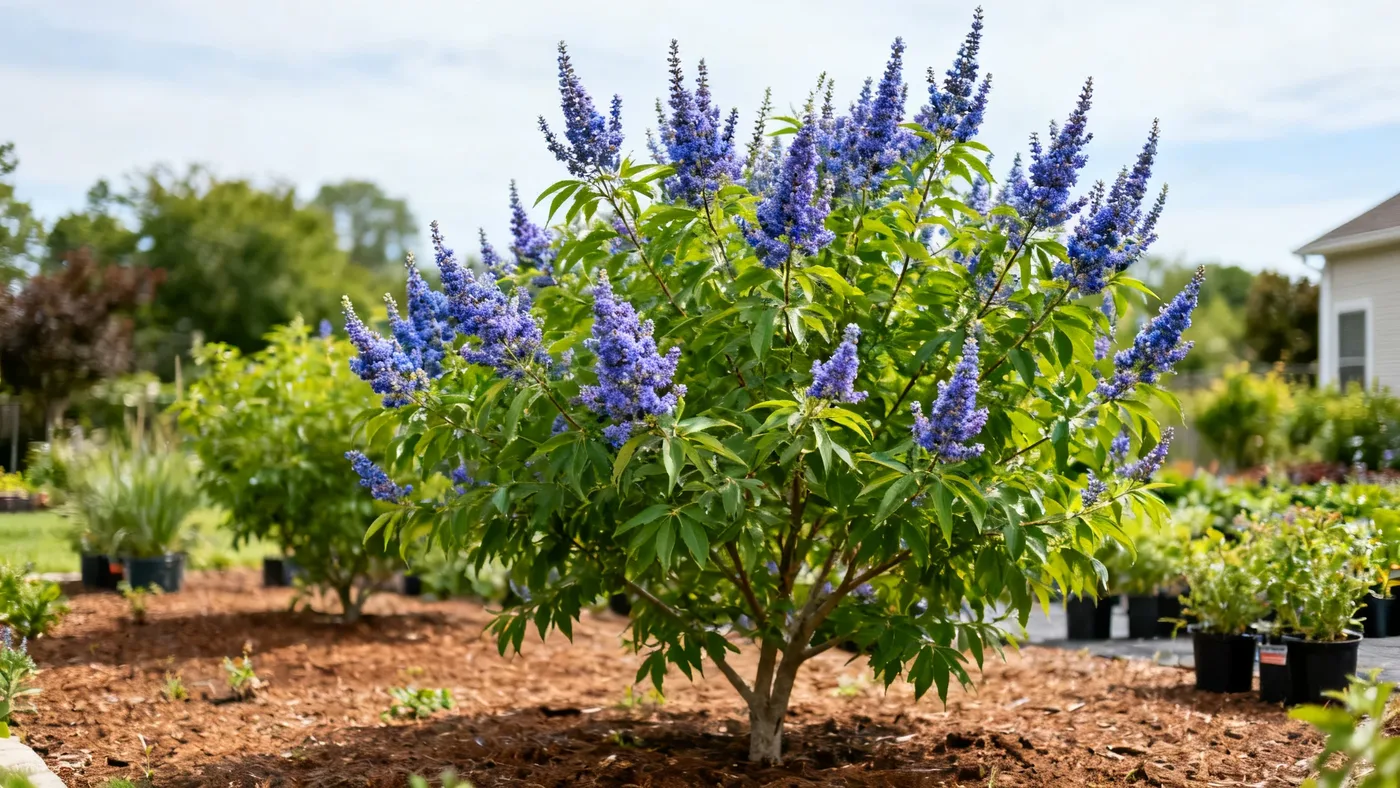
Pruning Shoal Creek Chaste Tree for Bigger Blooms
Pruning Shoal Creek Chaste Tree is not optional if you want full, abundant flowering. This deciduous shrub rewards hard pruning with vigorous new growth and a dramatic flush of lavender-blue flower panicles. If your plant looks leggy or sparse, or if flowering has slowed, improper pruning (or no pruning) is almost certainly the reason. The good news is that Vitex agnus-castus 'Shoal Creek' is forgiving and bounces back quickly when you follow the right schedule.
Why Pruning Matters for Shoal Creek Chaste Tree
Shoal Creek Chaste Tree blooms on new wood, meaning flowers emerge from branches that grew earlier in the same year. Without annual pruning, the plant becomes woody, its interior fills with dead twigs, and new flowers appear only at the branch tips, leaving the lower plant bare and unattractive. Annual hard pruning forces the plant to send out vigorous new shoots, each one capable of producing flower panicles from top to bottom.
Hard pruning also controls the plant's size. Shoal Creek typically grows 10 to 15 feet tall and equally wide, sometimes reaching 20 feet in ideal conditions. If your space is tighter or you prefer a more compact form, pruning by half each year will keep it well under control while actually increasing flower production.
Materials and Tools You'll Need
- Hand pruners or bypass pruners for branches up to 1/2 inch thick
- Loppers for branches 1/2 to 1 1/2 inches thick
- Pruning saw for branches thicker than 1 1/2 inches
- Pruning gloves or work gloves to protect hands
- Safety glasses (optional but recommended)
- Trash bin or yard waste container for clippings
- Sharpening stone or file to keep blades clean and sharp
Sharp tools make cleaner cuts, which heal faster and reduce pest and disease entry points. Dull blades crush stems and invite problems. Before you start, wipe your blade with rubbing alcohol if you have been cutting back a diseased plant, though disease is rarely an issue on healthy Shoal Creek.
When to Prune: Timing Is Everything
Prune Shoal Creek Chaste Tree in late winter or early spring, before new growth emerges. In zones 6 and 7 at the colder end of its range, this typically means February through mid-March. In zones 8 and 9, you can prune from January through late March. The exact date varies by your local weather, but the rule is simple: wait until the coldest part of winter has passed, then prune as soon as you see the buds beginning to swell.
Pruning at this timing serves two purposes. First, the plant has survived winter, so you can see which branches died back or were winter-damaged and remove them along with the rest. Second, pruning at this moment triggers a surge of new growth just as the growing season begins. The plant responds by sending out dozens of vigorous new shoots, all of which will flower by mid-summer.
If you live in zone 5 or the very cold end of zone 6, Shoal Creek may die back to the ground during winter and sprout fresh from the roots in spring. In that case, you do not need to prune; simply remove the dead wood, and the plant will emerge from the roots as a fresh, naturally well-shaped shrub.
Step-by-Step Pruning Instructions
Step 1: Remove all dead and diseased wood
Walk around the plant and identify any branches that are obviously dead (gray or black, brittle, leafless). Remove these first, cutting back to healthy green tissue or to the base. If you see branches with cankers, unusual discoloration, or soft spots, remove those sections too. This cleanup prevents pest and disease problems and gives you a clear view of the plant's living framework.
Step 2: Cut out crossing or rubbing branches
Look for branches that cross over one another or rub together in the wind. Rubbing creates wounds that invite insects and fungi. Remove the weaker or less favorably positioned of the two. This opens up the plant's interior, improves air circulation, and reduces congestion.
Step 3: Cut back the entire plant by one-third to one-half
This is the key step. Using your hand pruners, loppers, and saw as needed, cut back all remaining branches by approximately one-third to one-half of their height. If your plant is 12 feet tall, you are aiming to reduce it to 6 to 8 feet. If it is 6 feet tall, cut it back to 3 to 4 feet. Step back frequently and view the plant from different angles to maintain a balanced, open shape.
Make cuts just above an outward-facing bud or leaf node, angled slightly away from the bud so water runs off rather than sitting on the wound. Leave no stubs; a stub above a bud will die back and create an entry point for pests. For very thick branches or structural cuts, a pruning saw gives you better control than loppers.
Step 4: Open up the plant's center
Remove any branches that are growing downward, inward, or crossing through the center of the plant. The goal is an open, vase-like or fountain shape with good air circulation from the center outward. This encourages more flowering, reduces disease pressure, and makes the plant more attractive.
Step 5: Step back and assess
Once you have finished the hard cuts, stand back and look at the plant from all sides. It should look like a skeleton of thicker branches with stubby new growth points ready to burst forth. This can feel severe if you are pruning for the first time, but Shoal Creek is tough and very responsive. If a few branches look asymmetrical or too long, make light adjustments, but do not second-guess the main pruning; you have done the work correctly.
Deadheading for Continuous Blooms
Pruning in spring sets up the structure. Deadheading through the summer keeps flowers coming. Once Shoal Creek starts blooming in late May or June, spent flower panicles begin to brown and fade. Rather than let the plant put energy into setting seed, pinch or cut off these faded flowers just below the cluster, leaving the stem and foliage intact.
Deadheading is simple: use your hand pruners or even your fingers to snap off the spent panicle where it meets the stem. Deadhead every week or two throughout the bloom season (typically May through September) and you will prompt the plant to produce fresh flower flushes. Without deadheading, the plant eventually stops flowering and focuses on seed production, giving you weeks of non-bloom in mid-summer.
In very hot, dry climates, deadheading may tire the plant, so you can skip it or do it more lightly. But in most regions, deadheading is worth the few minutes of effort per week for months of continuous color.
Common Pruning Mistakes to Avoid
Pruning too late: If you wait until late spring or early summer to prune, you will cut off emerging flower buds and lose blooms for that season. Prune in late winter or very early spring, before the buds swell noticeably.
Pruning too lightly: Removing only the tips of branches does little to rejuvenate the plant. Commit to cutting back by a third to a half. The plant will thank you with dense, floriferous new growth.
Pruning in summer or fall: Late-season pruning can trigger tender new growth that will be damaged by the first frost. Stick to winter and early spring only.
Leaving stubs: Cuts should be made just above a bud or at the base of a branch. Stubs will die back and look ugly.
Using dull tools: Dull pruners crush stems instead of cutting cleanly. A crushed stem heals poorly and may attract insects or disease. Sharpen your tools before you begin.
Neglecting year-to-year: Skipping pruning one year does not kill the plant, but it will become overgrown and leggy. Even a light prune every spring keeps it healthy and full of flowers.
Expected Results
Within 2 to 3 weeks of spring pruning, you should see green buds swelling along the pruned stems. Within 4 to 6 weeks, vigorous new shoots will emerge. By mid-June or July (depending on your zone), these new shoots will begin flowering. The first flush is often the most prolific; if you deadhead those flowers, you will see a second, somewhat lighter flush in late summer.
By the end of the growing season, your pruned Shoal Creek should be fuller, bushier, and more flower-laden than it was the year before. The improvement is most dramatic the first year you prune a neglected plant; after that, annual maintenance pruning keeps it in top form year after year.
In terms of plant vigor, you may notice that the plant appears smaller immediately after pruning. Do not be alarmed. Its fast growth rate of roughly 2 to 3 feet per year means it will quickly fill back in. By late summer, your pruned plant will have regained significant size and structure.
Quick Reference: Pruning Checklist
| Task | Timing | Details |
|---|---|---|
| Hard pruning (main cut) | Late winter to early spring (Feb-Mar in zones 6-7, Jan-Mar in zones 8-9) | Cut back by 1/3 to 1/2 of height; remove dead/crossing branches |
| Open interior | During main pruning | Remove inward-growing or downward branches |
| Deadheading | May through September (throughout bloom season) | Pinch or cut off faded flower panicles weekly |
| Assess for shape | After final pruning cuts | Stand back; make light adjustments if needed |
| Expect blooming | Late May into summer, rebloom if deadheaded | Flowers emerge from new wood on pruned branches |
For more detailed care information on Shoal Creek Chaste Tree year-round, see our complete growing guide, which covers watering, soil, sun, fertilizing, and troubleshooting common problems.