Shoal Creek Chaste Tree vs Crepe Myrtle: Which Should You Plant
Stand in your yard on a hot July afternoon and count the visitors for ten minutes at each of two shrubs planted forty feet apart, a Shoal Creek chaste tree and a crape myrtle. The tallies are rarely even. Bees work the violet-blue spikes in steady lines while the other tree draws a lighter, more scattered crowd, and that gap tells you a lot about how the two plants live.
The choice matters because both are sold as the easy summer-flowering small tree, and each one punishes the habits that suit the other, from pruning to soil. Read on for how their bloom calendars, mature sizes, pruning, pollinators, origins and sites compare, and which one we would plant in which spot.
Two Summer Bloomers With Different Calendars
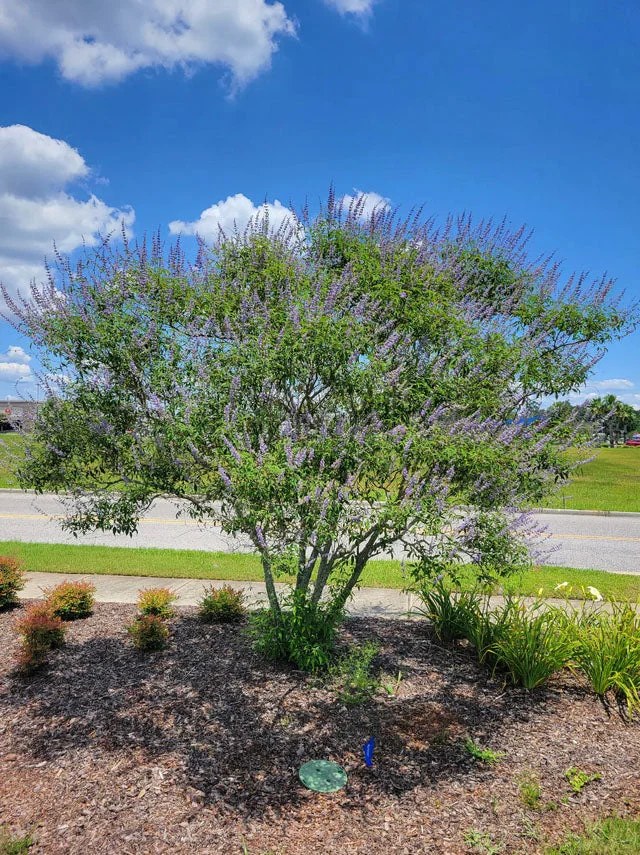
Shoal Creek Chaste Tree starts its violet-blue spikes in June and keeps blooming until September. Common crape myrtle blooms from July to September, so the two overlap for the back two-thirds of the season. The real difference is the front end. In June the chaste tree is the only one in flower, and it carries the yard alone until the crape myrtle catches up.
Where the Calendars Overlap
From July on, both are at full show, and that is where the comparison gets interesting. Stanford's tree encyclopedia places the showiest chaste tree flowering in July and August, which lines up almost exactly with the crape myrtle's peak. Customers usually ask us whether one tree can cover the whole summer. Not quite, but the two together come close, with the chaste tree opening the season and the crape myrtle holding the same weeks beside it.
Stretching Shoal Creek's Season
Shoal Creek has a trick the crape myrtle does not rely on. Removing old blooms encourages new growth with a repeat bloom in about six weeks. Cut off the spent spikes in midsummer and the second flush lands in late summer, when the crape myrtle is fading. Our pruning guide for bigger blooms covers how to do it without cutting more than you need.
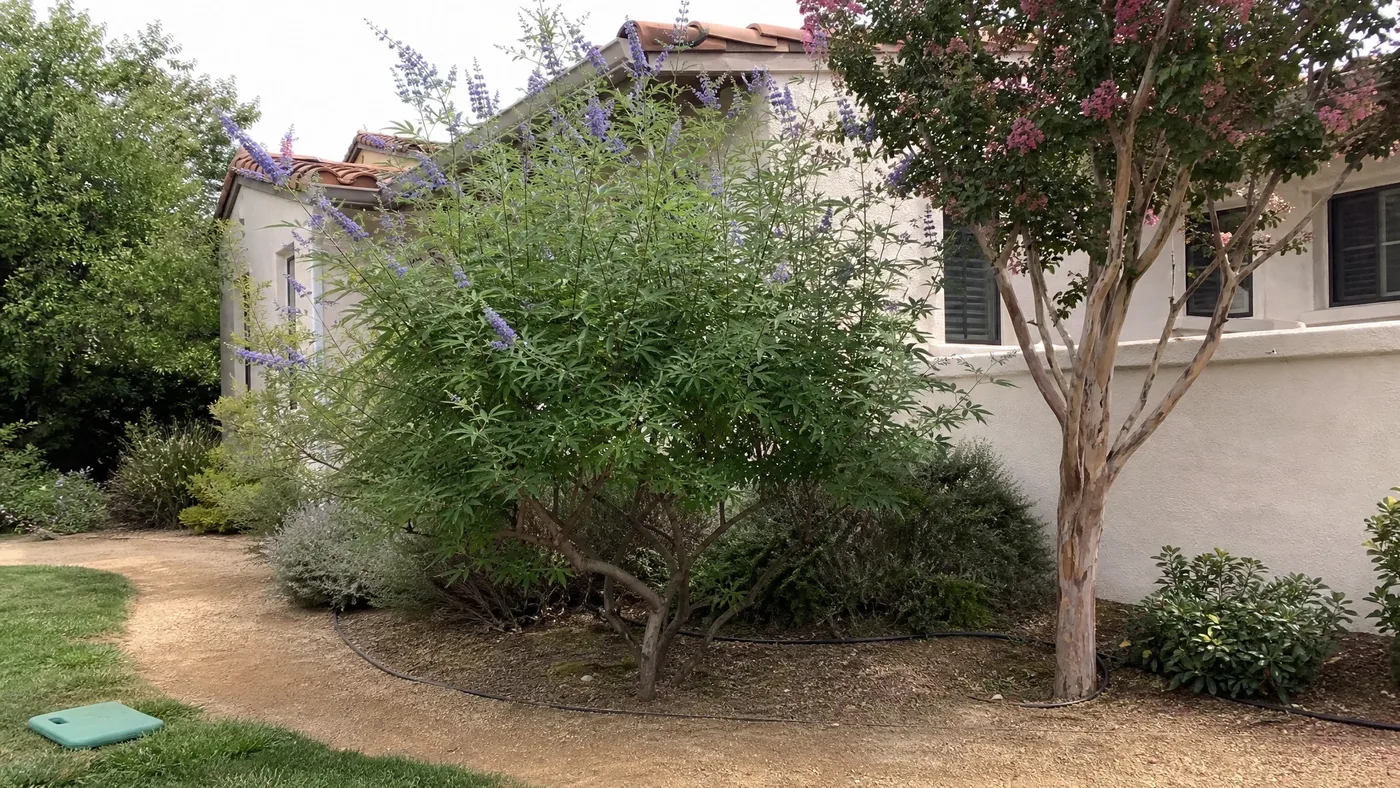
A Multi-Stemmed Shoal Creek Chaste Tree Beside a Tall Trunk
The two plants take up space in different ways. Shoal Creek grows 10 to 15 feet tall and 15 to 20 feet wide, so it is a broad, vase-shaped mound that is often wider than it is tall. Crape myrtle in its tree form runs 10 to 30 feet tall on a single or few trunks, with its canopy up in the air and the ground open beneath it. Our size guide covers the details of Shoal Creek's final dimensions.
Both grow quickly. Shoal Creek has a rapid growth rate, and common crape myrtle is a rapid grower too, one that can reach 6 to 30 feet high and wide, depending on the variety. That wide range is the catch with crape myrtle: the tag on the pot matters more than the species name. Shoal Creek is one named cultivar, so its size is easier to predict.
The table below sets the two side by side as the extension sources describe them.
| Trait | Shoal Creek Chaste Tree | Crape Myrtle |
|---|---|---|
| Mature height | 10–15 feet | 10–30 feet as a tree |
| Spread | 15–20 feet | Varies widely by variety |
| Growth rate | Rapid | Rapid |
| Hardiness zones | 6a–9b | 7A–9A |
| Habit | Multi-stemmed mound or vase | Upright trunk or trunks with a lifted canopy |
For a screen, the mound wins. It fills from the ground up, so a row of Shoal Creeks blocks a view at eye level in a way a row of trunk-and-canopy crape myrtles does not until the canopy fills in. If you want shade you can walk under, the trunk is the better shape.
Hard Pruning Is Right Here and Wrong There
This is where the two plants split most sharply, and where most mistakes happen. For crape myrtle, severe pruning or topping should not be needed to control the plant's size. If a crape myrtle is outgrowing its spot, the real fix is a smaller variety, not a saw. Cutting the top off leaves stubs that sprout crowded, weak shoots, and it spoils the shape the tree was bought for.
How to Prune Each One
Crape myrtle needs little pruning, and UF/IFAS says to do it in late winter or early spring before growth begins, when it is easiest to see which branches to remove. Remove crossing or dead wood, and leave the rest of the branching alone.
Shoal Creek is the opposite. Chaste tree can be killed to the ground in zone 6 and colder, and the plant regrows from the roots and flowers on that new growth. A hard cut in the dormant season is therefore normal practice, not abuse, and a plant cut back each year stays compact and blooms well. Deadheading in summer adds the repeat bloom described above.
- Never top a crape myrtle to hold it to a size it will not stay at. Choose a variety whose mature size fits the spot.
- Do not tiptoe around a Shoal Creek. A light trim each year leaves a tangle of old wood, while a firm cut in the dormant season gives you fresh growth to carry the flowers.
- Prune both before spring growth begins, and deadhead only the chaste tree.
What Bees Find on Shoal Creek Chaste Tree Flowers
The cultivar attracts butterflies, bees and hummingbirds, and the University of Georgia calls chaste tree's violet flowers a magnet for pollinators. The foliage is fragrant too, and the Virginia Tech dendrology factsheet describes the flower spikes as very fragrant. The long spikes open over many weeks, so there is always some nectar on offer from June onward. In our rows, the bees stay on the spikes through the hottest part of the afternoon.
Crape myrtle's flowers draw bees as well, but the extension sources we rely on do not list a pollinator crowd for it the way they do for the chaste tree. Watch your own trees before you decide. If a busy bee tree matters to you, Shoal Creek has the better paper record, and our guide on how Shoal Creek attracts bees and butterflies goes through who shows up and when.
Native Range Behind Each Plant's Habits
Neither plant is native to North America, and both come from warm regions of the Old World. Chaste tree grows in hot, dry-summer country, and its habits show it. Stanford's encyclopedia calls it heat-loving, and notes roadside examples blooming in midsummer to show its drought tolerance. It also has good drought tolerance once established. That is why it does well on a sunny slope.
Crape myrtle also loves heat, but its hardiness band is narrower in the sources we use: UF/IFAS gives zones 7A through 9A. Shoal Creek is listed at 6a through 9b by NC State, though Clemson recommends zones 7 to 9 and says it will have cold damage or be killed to the ground in zone 6 and colder. So it behaves as a perennial-like shrub in the cold end of its range, while crape myrtle simply stops there.
One more habit comes with that range. Clemson warns that chaste tree can reseed invasively, so ask your local extension service whether it is a concern in your area before planting.
Shoal Creek Chaste Tree on Sun-Baked Clay or Damp Lawn
Take a hot clay bank that bakes dry in summer. Shoal Creek wants full sun, at least six hours a day, and it grows in a neutral pH range of 6.0 to 8.0, so most native clays suit it. The risk is not the heat but wet feet: Arkansas extension notes root rot in heavy clay soils as the one real problem. Plant it high and loosen the hole as the soil guide describes.
Now take a damp lawn with a sprinkler zone. Chaste tree prefers loose, well-drained soil with adequate but not wet moisture, so a low spot that stays soggy is the wrong place for it. Customers often ask us to put one at the end of a lawn that stays wet. In our experience, crape myrtle takes ordinary lawn moisture better, though check your local extension office for soggy ground.
Sun-baked clay is workable for Shoal Creek if it drains. A damp lawn is not.
Planting Shoal Creek Chaste Tree Where It Fits Best
Our pick depends on the situation, and we would not call either plant the winner. We would choose Shoal Creek for the hot, dry, sunny spots where a crape myrtle struggles to look its best, and crape myrtle where you want a clean trunk and a tall canopy. The list below turns that into plain choices.
- For a wide screen along a property line, plant Shoal Creek and give it 15 to 20 feet of spread.
- For pollinators and fragrance, choose Shoal Creek, which blooms from June and carries the bees.
- For a single specimen with a trunk you can see, plant a crape myrtle and match the variety to the space you have.
- For a damp lawn corner, lean toward crape myrtle, and keep Shoal Creek on the drier ground.
- For zone 6, expect Shoal Creek to die back and regrow each year, and check with your extension service before choosing crape myrtle.
If you do choose Shoal Creek, our container size guide shows what to expect from the plants we grow.
A Season in the Yard With Shoal Creek Chaste Tree
Treat the two as partners, not rivals. Shoal Creek opens the season in June and carries the bees, and it can be cut back hard each year without harm. Crape myrtle takes the tall trunk and canopy role and should be left alone with the saw. Give each its proper site, dry and sunny for the chaste tree and ordinary soil for the crape myrtle.
Picture the yard through one summer: the chaste tree's violet spikes in June, the crape myrtle joining in July, both blooming together through August, and the chaste tree's second flush closing the season in September.
Shoal Creek Chaste Tree
Nursery-grown Shoal Creek Chaste Tree in sizes from QT Container 6-8 Inches Shrub Form, shipped to your door.
From $49.49
Shop Now →Our Shoal Creek chaste trees grow in open rows on our farms, with a full day of sun and loose soil that never stays wet. Every top-quality shrub we sell is raised by our own small team of growers, so we know how this one fits beside a crepe myrtle. Once you have settled on your pick, a Shoal Creek from our fields is ready to go in the ground.